

As the translation industry looks to the future, it stands on the brink of a monumental shift, driven by rapid advances in artificial intelligence (AI) and machine learning. The question on everyone’s mind is whether human translators will continue to have a role in a world where machines handle an ever-growing number of linguistic tasks. By exploring what the next 10 to 20 years may bring, we can better understand how translation will evolve—and where the human touch will remain irreplaceable.
The Next 10 Years: AI as an Unstoppable Force in Translation
Over the coming decade, the translation world will experience a seismic transformation, with AI systems becoming smarter and more context-aware. Neural machine translation (NMT) tools like DeepL, Google Translate, and Microsoft Translator are already impressively accurate, but they’re about to get even better.
1. Near-Human Accuracy and Contextual Awareness
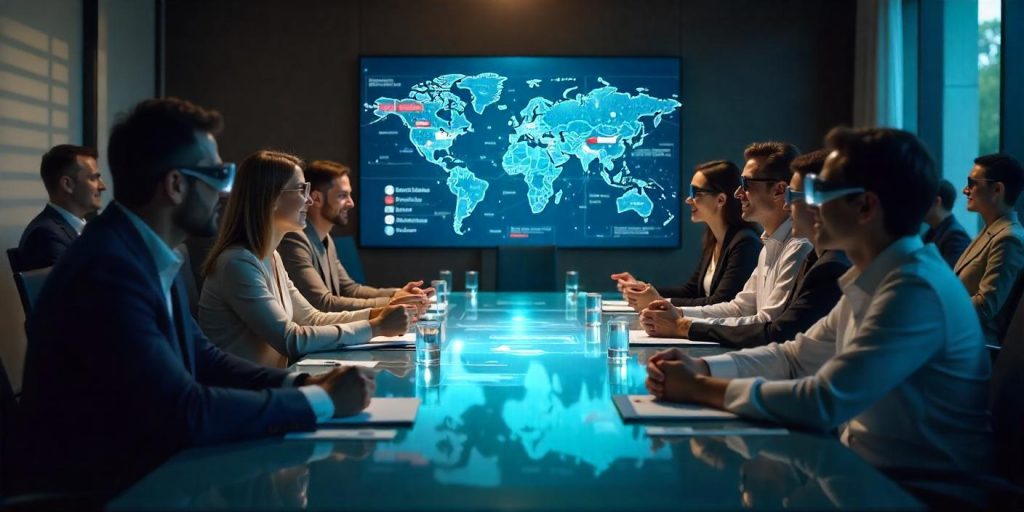
Imagine a business executive, Sarah, who regularly negotiates contracts with partners in Japan. Today, she still needs a translator sitting next to her to make sure the finer details of the agreement are crystal clear. But by 2034, Sarah might just put on a pair of augmented reality (AR) glasses that provide instant, flawless translations of everything her Japanese partners say, with full awareness of nuances and idioms. For Sarah, it will feel like she’s in the same linguistic space as her colleagues, without a language barrier slowing down discussions.
AI translation systems will be able to understand the intent behind words and provide accurate translation services even in complex scenarios. However, it won’t be perfect. Consider a stand-up comedian like Javier, who uses humor rooted deeply in his native Spanish culture. Even in 10 years, no AI will be able to generate the laughter that comes from understanding cultural in-jokes. Here, the human translator remains essential, as translating humor often involves creative reimagining.

2. Real-Time Translation Devices
Picture Maria, a tourist who finally decides to travel solo across Asia. Shortly, her experience could be revolutionized by real-time translation devices. As she walks through the bustling markets of Bangkok, her AR glasses will instantly translate every sign she sees into her native Italian, and an earpiece will interpret every conversation around her. Maria will feel empowered, engaging with locals more authentically than ever. These innovations will make travel more inclusive and enjoyable, but the devices won’t always capture everything perfectly. In culturally rich settings, like a traditional tea ceremony, the subtleties will still need a human expert to explain.
3. Post-Editing Becomes a Core Skill
While machines will do much of the heavy lifting, the role of the human translator will shift to post-editing machine translation (PEMT). Take Carlos, a professional translator who used to spend hours translating legal documents. Now, he finds himself reviewing AI-generated translations, correcting any inaccuracies, and ensuring that legal nuances are intact. It’s faster and more efficient, but Carlos’s legal expertise and linguistic flair are still essential. The AI might be good, but Carlos makes sure it’s perfect.
4. AI-Augmented Translation Teams
In translation agencies, we will see more AI-augmented teams. These teams will use machine learning models to speed up their work, yet will rely on human translators like Aisha for projects that require cultural sensitivity and a personal touch. When Aisha is asked to adapt a marketing campaign for the Middle Eastern market, she knows that simply translating the text won’t work. She must account for cultural norms, religious sensibilities, and preferred styles of communication—something no AI could fully grasp. This creative and strategic work will keep humans indispensable.
The Next 20 Years: Full Automation and Human-Centric Translation
Fast forward to 2044, and the translation industry will be almost unrecognizable. While AI will have made monumental strides, human translators will still have a vital role in certain areas.
1. Automated Translation for Everyday Use
Imagine a large multinational corporation like GlobalTech that needs to release a new product across 50 countries simultaneously. They’ll use an AI translation system that translates user manuals, FAQs, and technical support documents for every market—instantly. These AI systems will handle complex layouts, understand multiple languages in one document, and even translate embedded video instructions. This will cover around 90% of their translation needs, saving millions of dollars in the process.
2. Human Translators as Cultural Mediators
But what about literary translation? Picture Anna, a translator specializing in Japanese literature. She’s been asked to translate a moving new novel, rich with cultural themes, into French. The novel references traditional Japanese festivals, complex emotional dialogues, and subtle philosophical ideas. Even in 2044, no machine will be able to do justice to the book’s soul. Anna will spend months reading, understanding, and creatively translating the text so that it resonates with her French readers. Her work will be less about direct translation and more about bridging two cultures.
3. Niche Markets for Specialized Translators
Highly specialized fields like medical translation will continue to rely on human expertise. Consider Raj, a translator with a background in biochemistry. He’s working on translating research findings for a groundbreaking new drug. The stakes are incredibly high; one wrong word could change the entire meaning and put patients’ lives at risk. Raj’s knowledge of medical terminology and scientific nuances ensures that the translation is as accurate as possible. Here, human translators will always be critical.
4. New Roles: Linguistic Curators and Translation Ethicists
The future will also see the emergence of new roles. Linguistic curators will be professionals who train and fine-tune AI translation models for specific purposes. Picture Julia, who works for a global fashion brand. She spends her days feeding the AI system with phrases that align with the brand’s edgy yet elegant voice, ensuring the translations sound on-brand in every language. Then there’s Marcus, a translation ethicist, who reviews AI translations for bias and fairness. He ensures that all content is inclusive and culturally appropriate, helping companies avoid public relations disasters.
Will Machines Ever Fully Replace Human Translators?
Despite all the technological advances, it’s unlikely that machines will completely replace human translators. The reason lies in what makes language so deeply human.
1. Emotional and Cultural Intelligence
Machines cannot understand words’ emotional weight or the cultural context behind them. Translating a eulogy or a love letter requires more than linguistic accuracy; it requires empathy, cultural understanding, and emotional intelligence. While AI can mimic language, it cannot feel or interpret emotions, and there are moments when only a human touch will do.
2. The Unpredictability of Language
Languages are living, evolving things. New slang, social trends, and cultural shifts constantly emerge, and machines struggle to keep up. Human translators will always be needed to stay ahead of these changes, ensuring that communication remains relevant and effective.
The Human Edge in a High-Tech World
For translators like Anna, Carlos, Raj, and Aisha, the key to staying relevant will be adaptability and a willingness to embrace change. Rather than viewing AI as a threat, they will harness its power to focus on higher-level, more meaningful tasks. The translation industry of the future will be one where humans and machines work symbiotically, each complementing the other’s strengths.
Investing in new skills will be crucial. Translators who can guide and improve AI systems, refine machine translations, and offer cultural consulting will be in high demand. For translation companies like Littera24, the future lies in becoming multilingual consultancy firms, offering a blend of human creativity and machine efficiency.
In this high-tech world, translation won’t just be about words. It will be about bridging cultures, building empathy, and ensuring communication remains as human as possible—even in an era dominated by machines. The future of the translation industry is not a story of machines replacing humans but of humans and AI working together to bring people closer in a beautifully diverse world.


Leave a Comment